
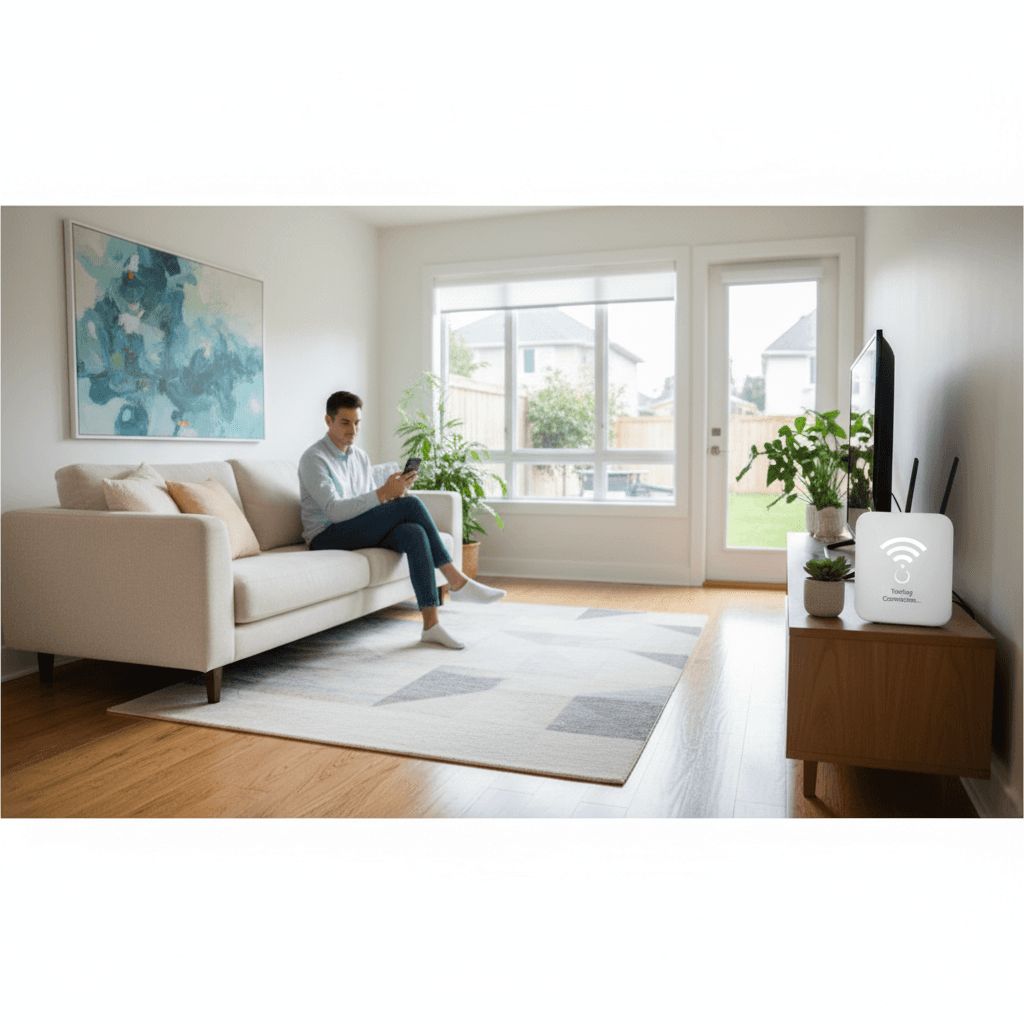
How to Fix Thick Walls and Appliances Killing Your Wi-Fi Signal
Physical obstructions are blocking your Wi-Fi signal - here's how to work around walls, appliances, and interference sources.
What's Happening
Your Wi-Fi signal drops dramatically when you move to certain rooms, even though they're not particularly far from the router. The culprit is physical obstructions - thick walls, metal objects, appliances, or even fish tanks blocking the signal. Unlike internet speed issues, this is purely about signal strength, and it requires strategic placement and sometimes additional hardware to overcome.
Quick Checks (Do These First)
- Identify your wall materials. Drywall is okay, but brick, concrete, and metal studs significantly block Wi-Fi.
- Look for appliances between router and problem areas. Refrigerators, microwaves, and metal furniture block signals.
- Check for water. Aquariums, water heaters, and pipes all absorb Wi-Fi signals.
- Test line-of-sight. Can you see your router from the problem area? If not, there's likely a physical obstruction.
- Use the 2.4 GHz band in these areas. It penetrates obstacles better than 5 GHz.
Step-by-Step Fixes
Fix 1: Relocate Your Router to Minimize Obstructions
Often the easiest solution is moving your router to a better location that avoids the worst barriers.
- Map out the thick walls and major appliances in your home
- Identify a central location that minimizes the number of walls between the router and high-use areas
- Move your router to this location (you may need a longer Ethernet cable to connect to your modem)
- Place the router in an open area, not inside cabinets or closets
- Elevate it 3-5 feet off the ground on a shelf or desk
- Keep it at least 3 feet away from metal objects and appliances
- Test signal strength in previously problematic areas
Fix 2: Angle Router Antennas for Better Penetration
External antennas can be positioned to better penetrate specific barriers if you can't move the router.
- Identify which direction the signal needs to travel to reach your problem areas
- If penetrating floors (up or down), position antennas horizontally
- If penetrating walls (horizontal travel), position antennas vertically
- For maximum coverage in all directions, use a combination: one antenna vertical, one horizontal
- If you have three or more antennas, experiment with different angles
- Test signal strength after each adjustment
Fix 3: Switch to 2.4 GHz for Better Wall Penetration
The 2.4 GHz band is slower but penetrates obstacles much better than 5 GHz. Use it strategically in hard-to-reach areas.
- On devices in rooms with signal issues, open Wi-Fi settings
- Disconnect from your 5 GHz network (usually has "-5G" in the name)
- Connect to your 2.4 GHz network instead
- Run a speed test - it may be slower than 5 GHz, but more reliable through walls
- For devices that stay in these rooms (smart TVs, desktops), keep them on 2.4 GHz permanently
Fix 4: Add a Mesh Node or Wi-Fi Extender in a Strategic Location
When obstructions are too severe to overcome with router placement alone, adding another node bypasses the problem.
- Identify a location between your router and the problem area where signal is still moderate
- This might be in a hallway or a room adjacent to the problematic area
- Place a mesh node or Wi-Fi extender in this intermediate location
- For mesh systems, follow the app's placement guidance
- For extenders, look for the "sweet spot" where it still gets good signal from the router
- The additional node creates a new signal source on the other side of the obstruction
- Devices in the problem area will connect to this closer node instead of fighting through walls to reach the main router
Fix 5: Use Powerline Adapters to Bypass Physical Barriers
Powerline adapters send your network signal through electrical wiring, completely avoiding Wi-Fi signal issues caused by walls and obstacles.
- Purchase a powerline adapter kit (two units minimum)
- Plug one adapter into an outlet near your router
- Connect it to your router with an Ethernet cable
- Plug the second adapter into an outlet in the problem room (on the other side of thick walls)
- Press the pair buttons on both adapters to establish connection
- If the adapter has Wi-Fi capability, it will create a new Wi-Fi access point in that room
- Otherwise, connect devices directly via Ethernet
Important: Plug directly into wall outlets, not power strips. Performance varies based on electrical wiring quality.
Fix 6: Identify and Reduce Active Interference Sources
Some appliances actively interfere with Wi-Fi when they're running. Minimizing their impact can improve signal.
- Test Wi-Fi signal strength with and without these appliances running:
- Microwave ovens (especially while cooking)
- Cordless phones (2.4 GHz models)
- Baby monitors
- Bluetooth devices
- If you notice significant interference from an appliance:
- Move your router farther from that appliance
- Switch to 5 GHz Wi-Fi, which isn't affected by most 2.4 GHz appliances
- Replace old cordless phones with 5.8 GHz or DECT 6.0 models
- Schedule heavy bandwidth activities when microwaves and other appliances aren't in use
If Nothing Worked
If you have extremely thick concrete or brick walls, multiple floors with metal reinforcement, or other severe physical barriers, consumer Wi-Fi equipment may not be sufficient. Consider professional-grade solutions like ceiling-mounted access points with wired backhaul, or running Ethernet cables through walls to create wired connections in problematic areas. Very old homes with metal lath in walls may need professional assessment.
When to Call a Pro
If your home has unusual construction (brick, concrete, metal studs), multiple floors, or you've tried everything without success, a professional can assess your specific situation. They can run Ethernet cables through walls, install access points in optimal locations, or recommend commercial-grade equipment designed to overcome severe obstructions.
Need Professional Help?
If you're in the Tampa Bay area, Geeks in Sneaks provides friendly, on-site tech support in Clearwater, Clearwater Beach, and Dunedin. We can assess your home's physical barriers and implement the right solution for reliable Wi-Fi throughout your space.
Related Topics
Need Professional Help?
If you're still having trouble, our expert technicians can help.
Learn about our network repair serviceMore Router & WiFi Fixes
See all Router & WiFi fixes →Business-Grade vs Consumer Routers for Home Use
Considering a business-grade router for your home? Find out if the premium price delivers real benefits for residential use.
Buying Used or Refurbished Routers: Safe or Risky?
Tempted to save money with a used router? Learn the real security risks and when buying secondhand is safe versus when it's dangerous.
How Long Should a Router Last? When to Replace Yours
Your router is a few years old and you're wondering if it's time to replace it. Learn the typical lifespan and warning signs it's failing.
Gaming Routers: Real Benefits vs Marketing Hype
Wondering if a gaming router is worth the premium price? We separate the real performance benefits from marketing gimmicks.
Renting ISP Equipment vs Buying Your Own: Real Cost Comparison
Paying monthly rental fees for your modem and router? Find out how much you could save by buying your own equipment.
Matching Router Capabilities to Your Internet Speed Tier
Have gigabit internet but not getting those speeds? Your router might be the bottleneck. Learn how to match equipment to your plan.
When to Move from Single Router to Mesh WiFi System
Dead zones and weak WiFi in parts of your home? Find out if it's time to upgrade from a traditional router to a mesh system.
Dual-Band vs Tri-Band Router: Who Actually Needs It?
Wondering if a tri-band router is worth the extra cost? We'll break down the real differences and help you decide what's right for your home.